
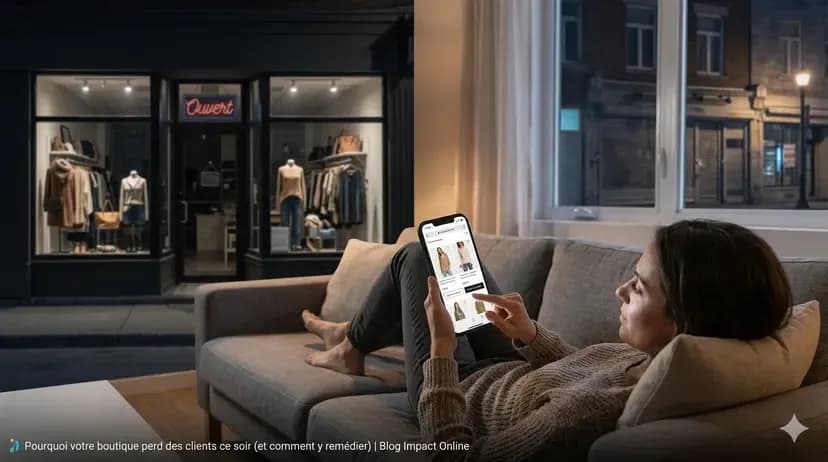
Why your brick-and-mortar store is losing customers tonight, and how to fix it
At night, your customers search online while your door is locked. Here's why a brick-and-mortar store loses sales in that moment, and how to take your store online at your own pace without putting it on hold.
A brick-and-mortar store loses customers after hours when those customers search online and can't find it: not its products, not its opening hours, not a way to order. The fix isn't to close the store and bet everything on the web. It's to take your store online with a storefront that answers when the door is locked, at a pace that works for you.
This isn't a leap you have to make all at once. It's a mountain that looks steep from the bottom, but you climb it one step at a time, and you don't have to climb it alone.
What happens after you close
Picture it. It's 9:30 on a Thursday night. A shopper is looking for a pair of boots on her phone, settled on the couch. She thinks of your store: she stopped by last week and liked what she saw. She types your name. She finds an address, maybe your hours, but no products and no way to order. A few results down, another merchant shows her exactly the boots she wants, with delivery or pickup the next day.
You didn't do anything wrong. Your store was closed, like every night. The difference is that the other merchant had left a door open online.
Your store isn't under threat, it just isn't alone
You often hear that online shopping will replace physical stores. The numbers say otherwise. In Canada, for example, e-commerce made up 6.8% of retail trade in May 2026, according to Statistics Canada. Most buying still happens somewhere other than an online cart.
The web is used for more than buying, though: it's used to decide. Before making the trip, a shopper checks whether you carry the product, when you open, what your store looks like. If that information isn't online, they don't look much further. The store stays at the heart of your business; what's missing is a way to be found when it's closed.
Why taking your store online feels so steep
When a merchant thinks about selling online, they see everything at once: picking a platform, photographing every product, writing every listing, keeping inventory in sync between the store and the site, packing and shipping orders, answering emails, getting found on Google, all while still serving customers at the counter. Seen that way, it's an impossible climb.
Most people expect they have to put everything online before opening. In reality, nothing says you have to start at the top. An online store can start small, with a few products and in-store pickup, then grow at the pace your customers ask for.
Three common mistakes when getting started
- Waiting until everything is perfect. An online store that waits to be complete never opens. A well-made first version with a handful of products teaches you more than months of preparation.
- Forgetting about Google. When someone searches "shoe store near me," your Google Business Profile and your site answer for you. An incomplete profile or outdated hours lose a customer before they've even seen your products.
- Copying the store instead of translating it. What works at the counter, the advice, the smile, being able to touch the product, has to be expressed differently online: good photos, descriptions that answer questions, clear shipping and return policies.
Where to start, step by step
Here's an order that lets you sell online without putting the store on hold:
- Update your Google Business Profile: opening hours, recent photos, a link to your site. It's often the first place a customer sees you.
- Pick a small selection of products, your best sellers or the ones people ask about most, and present them well instead of putting everything online.
- Offer in-store pickup to start. The shopper orders at night and picks up the next day: no shipping to organize, and they come back into your store.
- Keep one inventory. With Shopify, for example, your in-store checkout and your online store share the same inventory: a sale at the counter updates the site.
- Tell your current customers: at the register, in your newsletter, on social media. They're the ones who'll place your first online orders.
For the Google side, from your Business Profile to how your pages rank, that's what Google ecosystem support covers. And when it's time to write your listings, the most common mistakes on Shopify product pages will save you a few detours.
Why you don't have to climb alone
What makes the climb steep isn't any one step. It's carrying all of them at the same time as running the store: the shop, the listings, the photos, Google, shipping. That's why I work with independent merchants on everything that leads to a sale, with one point of contact from start to finish.
I also built a tool that creates an online store in an automated way. It's like baking cookies with a cookie cutter: the first one takes the longest, because you have to make the cutter, but the rest go much faster. The heavy lifting is done once, in the tool, which lets me make this kind of support accessible to a neighborhood shop. To see what getting started includes, take a look at support for setting up your online store.
Frequently asked questions
Do I need to put all my products online?
No. Start with a well-presented selection: your best sellers, or the products people call to ask about. Add the rest once you see what sells online.
Do I have to ship everywhere from day one?
No. In-store pickup and local delivery are good first steps: they keep logistics simple and bring customers back into your store. Shipping farther can come later.
Will an online store empty out my physical store?
Its main job is to get you found when the door is closed. A shopper who sees your products online at night may well come in to buy them the next day. Done well, it works for the store, not against it.
If you'd like to see where to start for your business, fill out the form or message me privately. We'll look at your situation together, no jargon and no hard sell.