
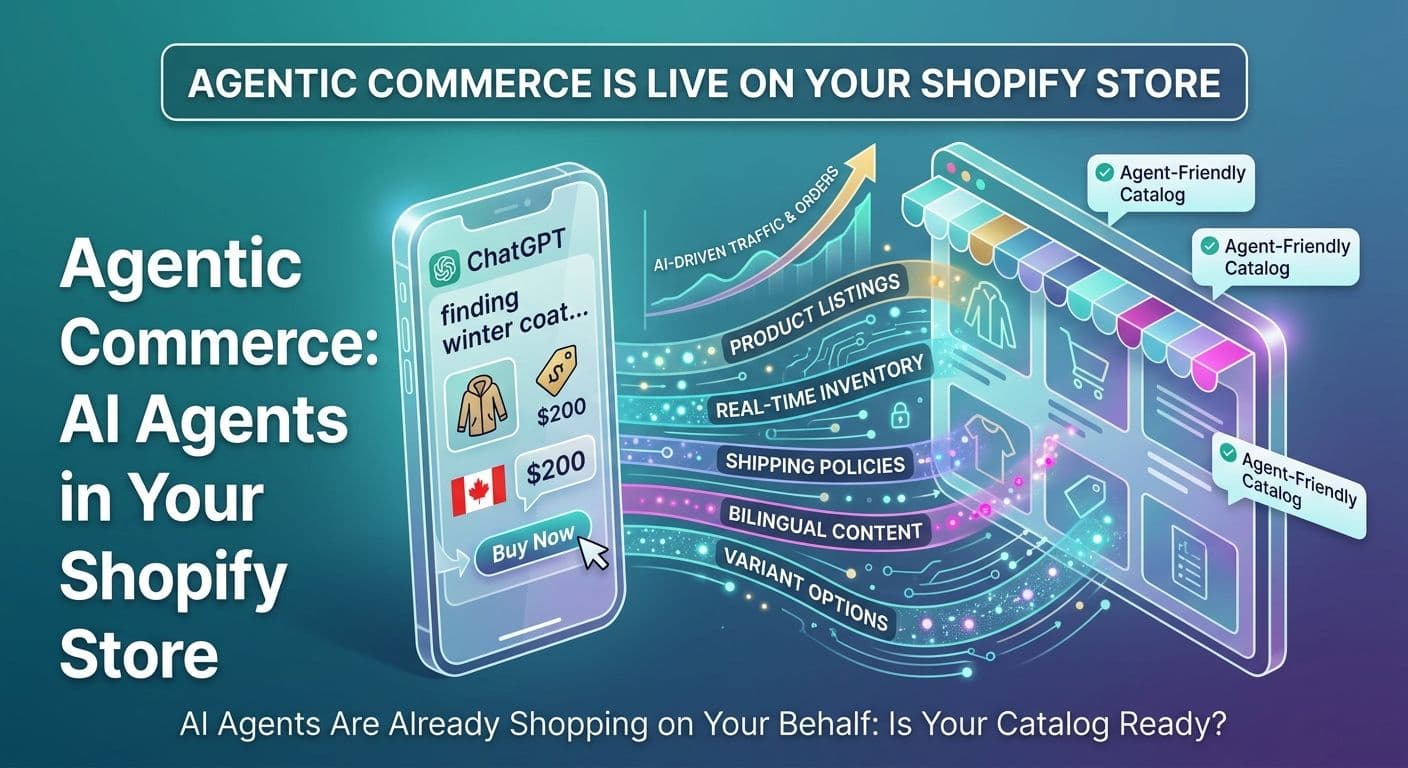
Agentic commerce is already live on your Shopify store
Your Shopify catalog may already be read by assistants like ChatGPT. Here's what that means, what the numbers really show, and what to check so those assistants recommend your products.
Agentic commerce is when an AI doesn't just answer a shopper's question: it gets things done. It searches for products, compares them against what the shopper asked for, then carries the purchase through. On Shopify, the feature is already in place for eligible stores, so your catalog may be read by these assistants without you having set anything up.
So the useful question is no longer "am I in?" but "are my products clear enough to be recommended?" Being readable by an assistant and being recommended by one are not the same thing, and that gap is where you can act.
What is agentic commerce, in plain terms?
A regular AI answers your questions. An agentic AI carries out tasks: it doesn't just respond, it accomplishes. Applied to shopping, it looks like this. Picture a shopper who asks ChatGPT to find a men's winter coat, delivered within a week, within a set budget. The assistant goes through store catalogs, keeps the ones that match, and suggests a few products. Yours is one of them, or it isn't.
For a merchant, the shift matters: the shopper doesn't necessarily walk past your storefront. The assistant reads your catalog on their behalf, product by product, and decides what to show. What counts to it is what's written and structured in your listings.
What Shopify has turned on for your store
On its dedicated page, Shopify says Agentic Storefronts is "enabled automatically for eligible stores." It explains that its catalog structures your product data so AI can find and present your products, including in ChatGPT and Gemini.
The page doesn't spell out the eligibility criteria, and the guides published on the topic don't all agree on which assistants are on by default. The most reliable move is to look directly in your store's admin: Shopify says you decide where your product data is shared.
The numbers, and what they don't tell you
These figures come from Shopify's Q1 2026 results, as reported by PYMNTS. They're real, but a growth multiple says nothing about the starting volume, and they cover Shopify stores as a whole, not yours. They show a direction, not a promise of sales.
They also don't say how those purchases are completed, or how much of the growth goes to small stores. What they do show is that visits and orders coming through assistants are growing fast, and an assistant has to understand your products before it can suggest them.
Agentic commerce isn't a product to sell your customers. It's a new way AI reads your store.
What helps an assistant recommend your products
An assistant reads data, not a storefront. Here are the five things I'd look at first, because they also help your ranking on Google.
Clear, accurate product listings
A description that says what the product is, what it's made of, who it's for and what sets it apart answers the questions a shopper puts to the assistant. A description stuffed with piled-up keywords helps neither the shopper nor the assistant.
Current inventory and pricing
An assistant that suggests a sold-out product, or one shown at the wrong price, disappoints the shopper and the store along with it. What your catalog says should match what you can ship today.
Content written in every language you sell in
If your customers search in more than one language, each listing should exist in each of them, written in that language, rather than translated on the fly when the page is displayed. If you sell in one language, put that effort into making each listing complete instead.
Consistent variants and images
Color, size, angle: each variant should have its own images. A listing whose images don't match its variants leaves the assistant, and the shopper, guessing.
Explicit shipping and return policies
These are the questions shoppers ask before they buy. When the answers are written clearly in your store, the assistant can rely on them instead of leaving the question open.
Where to start, without a special project
You don't need to rebuild your store. A simple check will show you where you stand:
- Open three of your best-selling products and read their descriptions as if you didn't know the store: is everything a shopper would want to know there?
- Compare the stock quantities shown with your real inventory.
- If you sell in more than one language, make sure each listing exists in each of them, written in that language.
- See whether each variant has its own images.
- Reread your shipping and returns pages: do they answer your customers' questions?
- In your Shopify admin, find where your product data is being shared.
Should this be a priority right now?
Honestly, it's not the most urgent item on your list, and you don't need a dedicated "AI project" to benefit from it. Shopify handles the technical plumbing. The work that matters is the work that has always been recommended for SEO and conversion: a clean, current catalog that's consistent from one listing to the next.
Plenty of merchants once said "I only take cash" before they accepted cards. The move toward assistant-led shopping looks a lot like that: nobody had to rebuild everything, they just had to be ready when customers started asking for it. The store stays; you add one more way to be found.
If your catalog is already solid, agentic commerce extends your visibility without new work. If it isn't, that's a good reason to put it in order. It's the work I do with merchants through my product listings and Google ecosystem services. You can also start with the most common mistakes on Shopify product pages.
Frequently asked questions
Does agentic commerce matter for a small store?
Yes. What an assistant reads is your listings, not the size of your catalog. A small store with clear, complete listings is easier to understand than a large catalog with empty descriptions.
Do I need to rewrite all my product listings?
No, not all at once. Start with your best sellers: those are the products shoppers are already looking for. Once you know what's missing on those, you'll know what to fix on the rest.
How is this different from ranking on Google?
A search engine shows a list of links and the shopper picks one. An assistant suggests a few products directly. The groundwork, clear and current listings, is the same: it's just read by a new kind of reader.
If you'd like to know whether your catalog is ready, fill out the form or message me privately. We'll look at where to start together, no jargon and no hard sell.